The summer curriculum is shaping up.
Haley has both art and music camp for a week. Haley also has a pre-algebra math course and (a likely) weekly creative writing class. I've found what seems like a great horseback riding teacher locally (and inexpensively). And, she will continue her harp/piano throughout the summer.
Ian, has more "relaxation time" (which he'll enjoy) with 2 weeks of art camp, and continuation of kung-fu. He'll also do horseback-riding (as will little sister, Hana). And, so far, that's where we are.
I'm looking for an IT course of some sort (I think he'll like that). And maybe...a photography course.
We have a few trips planned: Portland, OR; Atlanta, GA; and Washington DC (July, August, September). We intend to host out-of-town guests (Grandma and Auntie). We are planning to train our dog in a structured fashion (albeit this is low on the priority list right now because Ian is a bit young).
Ian and Haley both have their study tablets (that they mostly play games on currently). The outside room is coming along slowly (had other priorities INSIDE the house before working outside of our living space). And as Haley finishes up her (exceedingly unproductive) last days of school (where, now that the STAAR test is over, she spends all day sitting on the floor or a tent, reading) we are excited to be moving on to the next thing.
I did inquire about absences (more for Hana next year), because this may be a reason to pull Hana out of public school. Afterall, they threaten to call CPS if the child misses "too many days" of *optional* kindergarten?!! OR...we can just keep her home.
Turns out the kids can miss 17 days of school. They have only missed 5. So, we could keep them home the rest of the year and not get to 17 (which is nice). Especially since, I have plans for them and will likely keep them home a few of these days (Grandma in town, math camp begins, etc).
So, in the spirit of "finishing strong" and "stick-to-it-ness" the kids finish out their academic year in Public school.
Tuesday, May 28, 2013
Friday, May 10, 2013
It's Spring time - Garden, swimming, riding bikes.

Creating drainage holes. Pebbles at the bottom of the container help with irrigation/drainage.

Sowing the seeds

New baby chicks (and practicing photography).


Ian and Hana learn about water safety.


Life without training wheels is a life well-lived.
Ian learns to ride his bike

Thursday, May 9, 2013
The Year of Learning Dangerously
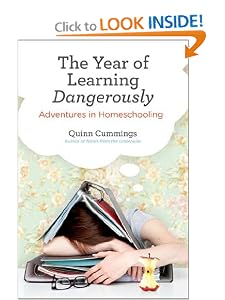
When we started this experiment, I thought I knew what a typical homeschooling family looked like. Homeschoolers were either fundamentalist Christians who wanted to isolate their children from the corrupting influence of modern society or off-the-grid hippies with a reflexive fear of authority and an inclination to make their own yogurt and shoes.
http://www.takepart.com/article/2013/04/26/homeschooling-harmful-myth-debunked?cmpid=wfs-fb
Thinking about buying this book (when it comes out in paperback sometime in the Fall). Right now, I have enough reading material to keep me busy until then (so why purchase the hard-back right now?). Besides, I like paperbacks better.
Update: 7/3/13
Got the book on sale from Amazon. About a third of the way done. LOVING IT!!
Wednesday, May 8, 2013
Learning styles and nuances of intention

I'll shamelessly admit that so many of my blog entry inspirations this early in the game arise from other blogs. A few days ago I read "School is a competition where winners get nothing" and felt motivated to share these ideas on my own blog (more for future reference for myself, which is the singular purpose of this entire blog, actually).
What was particularly interesting to me is how Penelope states the obvious:
You already know that everyone learns differently. You already know that each kid has different interests, and you know that kids learn at different rates. So you know, intuitively, if you set up school to be a competition, it will not be close to a fair fight.
You won't have all the math kids competing against each other in math and all the artists competing against each other in art. You actually have the math kids competing in art and the art kids competing in math, because the idea of school is not only competitive, but also pushes the idea of well-roundedness.
1. Testing gives people a way to rank kids.
2. Report cards give parents a way to rank themselves based on how well their kids learn.
3. School measures IQ not only with testing, but by setting up discrete subject matter that requires basically one type of IQ.
So obviously true. Last night, when I explained this to Haley, she understood immediately. See, Haley has a friend who does VERY well in school. Her learning style is conducive to how information is presented in school. She has the natural personality to accept what's said as fact, doesn't have tons of questions about "why?" and is able to memorize and regurgitate those facts on a multiple choice survey.
And that makes her "gifted." That makes her "intelligent."
Haley has TONS of questions. And takes nothing as a 'given fact' just because some 'random' person tells her it's truth. She's a thinker.
Additionally, I believe, in addition to the various *known* learning styles (see below) there are subtleties and nuances that are not being accounted for. Such as complementary energy, intention, interpersonal interaction, and other influences that are difficult to articulate, much-less analyze.
Take for instance a dog. If you love the dog (and the dog *knows* you love him), he is more eager to please. And even when you're having a "bad day" and being impatient, the dog KNOWS you love him, and will happily tolerate you, and try even harder to please you...to make you feel better. The dog is more responsive, and feels like he's important to you.
On the contrary, if the dog senses animosity or resentment from you...or if the dog doesn't feel like you like him, he will be less enthusiastic about learning from you. Even a smart and motivated dog will sense the negative energy from it's trainer, and that trainer will be less likely to pull excellence out of that dog.
Of course children has this ability as well. The ability to sense the *motives* of the person who's offering the advice or teaching the "lesson." And the more sensitive the child to this energy, the less likely they are to wholeheartedly accept information as truth in their lives from "negative" people.
School teachers (while intentions may start out altruistic and genuine) are jaded and cynical. Especially when interacting with a child who may be from a family that coincides with their own beliefs. Or, they may begin to put of an emotional wall when interacting with "problem" children (i.e. children who ask 'why?'). Because, answering the "why?" isn't always easy. Because answering the "why?" requires the teacher to think. And they aren't rewarded for thinking...
Parents, on the other hand, (barring those rare parental misfits) care the MOST about their children. No one cares more. Therefore, the chances of your child performing better for you (even in a 'weaker' subject) are much greater. The energy is not weird. And the environment is not competitive for the sake of ranking students (and parents) based on arbitrary criteria that do not result in success, peace, or any other relevant "happiness indicator" in the world. So what's the point?
My children have talents that are not measured on the STAAR test. My children have attributes that go unappreciated in traditional school classrooms in this country. My children are bright, funny, caring, helpful, artistic, athletic, compassionate, honorable little people...and their life light shines bright.
In the early years (kindergarten, 1st grade, etc) the teachers tend to be nice and more understanding of the innate genius that each child possess. And traditional school may work well - and actually prove beneficial in allowing the proverbial socialization (especially for the oldest/only child). However, as children get older, and their uniqueness really takes center-stage (coupled with *many* social outlets via siblings and extracurriculars the traditional model may be less beneficial. Especially in the setting of test-overemphasis and focus on grades and memorization...traditional school can become very detrimental to many children.
Learning Styles:
- Visual: The occipital lobes at the back of the brain manage the visual sense. Both the occipital and parietal lobes manage spatial orientation.
- Aural: The temporal lobes handle aural content. The right temporal lobe is especially important for music.
- Verbal: The temporal and frontal lobes, especially two specialized areas called Brocas and Wernickeïkis areas (in the left hemisphere of these two lobes).
- Physical: The cerebellum and the motor cortex (at the back of the frontal lobe) handle much of our physical movement.
- Logical: The parietal lobes, especially the left side, drive our logical thinking.
- Social: The frontal and temporal lobes handle much of our social activities. The limbic system (not shown apart from the hippocampus) also influences both the social and solitary styles. The limbic system has a lot to do with emotions, moods and aggression.
- Solitary: The frontal and parietal lobes, and the limbic system, are also active with this style.
Monday, May 6, 2013
Observations
 For some (odd) reason, I feel the need to emphasize that this entire home-schooling decision was prompted by Haley, and solely fueled my desire to see her ENJOY learning (and realizing I can't do *worse* than the intermediate school she currently attends. There is no "problem" per se.
The Public elementary school that Haley attended, and Ian currently attends, has been great. But as I investigate homeschooling, it's becoming clear that this might be the way to go for Ian as well (considering his personality).
Additionally, (again, for some odd reason) I feel the need to 'justify' why Hana's going to the Public school while I pull the older ones out. The short answer is, it worked well for the other two children, and I don't anticipate it won't be equally (if not MORE effective) for Hana (based on her personality and learning-style).
Besides, if Hana begins to regress back into her RAD, that may be an indication to go ahead and pull her out of Public school too. She's done so well at home. I must admit I'm a tiny bit concerned about sending her to another 'institution' if she hasn't fully recovered from earlier childhood adversities and issues. But, because the school is a good school, I feel its worth giving it a try. With a small element of RAD, she may be 'protected' from the opinions of others (as she doesn't really care what they say), and with the dishibited form she displayed, residually that may serve to enhance her ability to make friends, "fit in" and enjoy it fully. Bottom line, she just might excel and thrive. And that would be a great thing!
Anyway...
I read this story today, and it really resonated with me. As I try to work through my thoughts, ideas, expectations, justifications, uncertainties, and excitement about home-schooling, I find myself full of "words." So many words that it takes awhile to prune my thoughts into coherent aliquots that can be subsequently expressed verbally (or in writing)!
Therefore, I was *delighted* to see "my words" so succinctly stated:
Unless you have lived through academic struggles with a child who is a misfit for school, it is hard to describe the impact on the family. Tears, sobbing, pleading, punishment, crumpled & torn paper strewn across the floor, pencils cracked in frustration & anger, books thrown across the room, yelling, doors slamming, sullen eyes, silent treatment….entire afternoons and evenings derailed by academic drama.
And that's just after school. There's also the mornings of pulling them out of bed over and over again, threatening to leave them home, skipping breakfast, begging, pleading, water thrown on their head to get them to wake up. Something that is so simple (get up, go to school, do homework) becomes so complicated, so dramatic, clouding everything in your world. It's a full time, exhausting, no-reward effort, debilitating for everyone....
My son has good intentions—always a willing participant in trying a new approach. He wanted the positive glow of a great grade. But he could not sustain the effort needed to achieve it. So every new attempt would last a day or a week or a month until he lost interest...
Looking back, I have known for years that he was in the wrong place academically. And I feel deep shame that I didn't take action sooner...
My observations coincide with hers in many respects. While my child didn't have the issues her child does (perhaps because she's younger and female) I can see some of the positive changes in Haley *already*, just with the prospect of home-schooling. It's amazing, actually. And maybe...the change isn't JUST with Haley. Maybe the entire family has been affected by the *prospect* of homeschooling.
Like the author, I do wonder 'what took me so long' to realize (after multiple schools and educational home supplementation) that traditional wasn't really yielding expected results? I think I kept waiting for it to get better. "Fourth grade is when you learn all the really important stuff....so we'll see how 4th grade goes." And when it didn't happen in 4th, the thought became, "Well, maybe in fifth grade the magic happens these days, when she finally breaks off and goes to *intermediate* school..."
One HUGE, very specific change I've noticed with my child *already* (even though nothing else has changed. She still attends Public school. She has the same 'friends.') is she's so relaxed and treats her siblings much nicer. She went from "No one in my room!!" to "Can Hana and I have a slumber party?"
And as further evidence of her 'more relaxed state', I've noticed that she's not so stressed out (frustrated, asking questions before thinking for herself, crying, etc.) when WE go over things together at home. I was able to teach her the Spanish verb conjugations with a few tears. I was then able to teach her the Spanish alphabet with NO tears. And just last week, I was able to teach her percents, proportions, ratios, and review long division via Khan Academy...and it was AWESOME. Not only were there no tears...we actually had a good time.
After the time was up, she wanted to keep going!! I think she realizes that...there is no hurry to learn it before "the class moves on." There is no reason to "slow down" in order to not leave a kid behind. She has as much (or as little) time as she needs. She can take the lesson in a completely different direction that what was initially intended....and learn with enthusiasm.
We both had a good time. AND, when we went grocery shopping, she was able to actually figure out "which one is the best deal." This has been a sore spot for 2 years with us (whereby she couldn't think of the math 'fast' enough so she'd immediately become anxious and frustrated. Eventually, she didn't even want to try...).
This is encouraging because...we haven't even started our home-schooling yet.
Sunday, May 5, 2013
Backwards Math
[After teaching my child backwards math] "I assumed that the next logical step would be to teach the standard algorithm for addition, whereby the numbers are stacked and added one column at a time (as students have been taught to add since time immemorial). Yet to my horror, the bottom of the page had the standard algorithm written with a big “X “over the top. The page encouraged parents not to teach their child to use this method...." (??!!)"She informed me the district had adopted a math program where they were focusing on “deep understanding,” ...I realized that I was not going to change her mind about the value of standard algorithms. ... I decided to supplement my son’s math instruction at home. This plan absolutely backfired. Supplementing, it turned out, became a nearly impossible task. Our tutoring sessions become increasingly adversarial, with my son ending up in tears multiple times because I was telling him to solve the problem one way and his “teacher doesn’t do it that way,” because she discouraged him from using the standard algorithm...."
THIS, is our story too!! - with Haley
Everyday math is bad news. Horrible social experiment where the children pay the highest price. Lets not forget the failed "whole language" reading * experiment* that has yielded raised the statistic of illiterate adults today.
When California instituted the "whole-language" approach to reading nearly a decade ago, it abandoned a tested and proven method - phonics - in favor of one that has children guessing at words and inventing their own spelling and grammar. Whole language quickly spread to virtually every public school . Attempts to restore phonics were rebuffed by the teachers' union and educational "experts," who claimed the new way was better.
. Attempts to restore phonics were rebuffed by the teachers' union and educational "experts," who claimed the new way was better.
The results of this new approach are now in. Standardized tests in California placed that state's public school children in a tie for last with Louisiana as the worst readers among 39 states tested.
And now, the "new focus" is on math. I guess these people who sit around and think of these things...just don't have anything more productive to do. OR (more likely) in an attempt to justify their existence come up with random shit every now-and-then to shake things up.
But the price of not learning how to read...or do math...is to high!!
Subscribe to:
Posts (Atom)